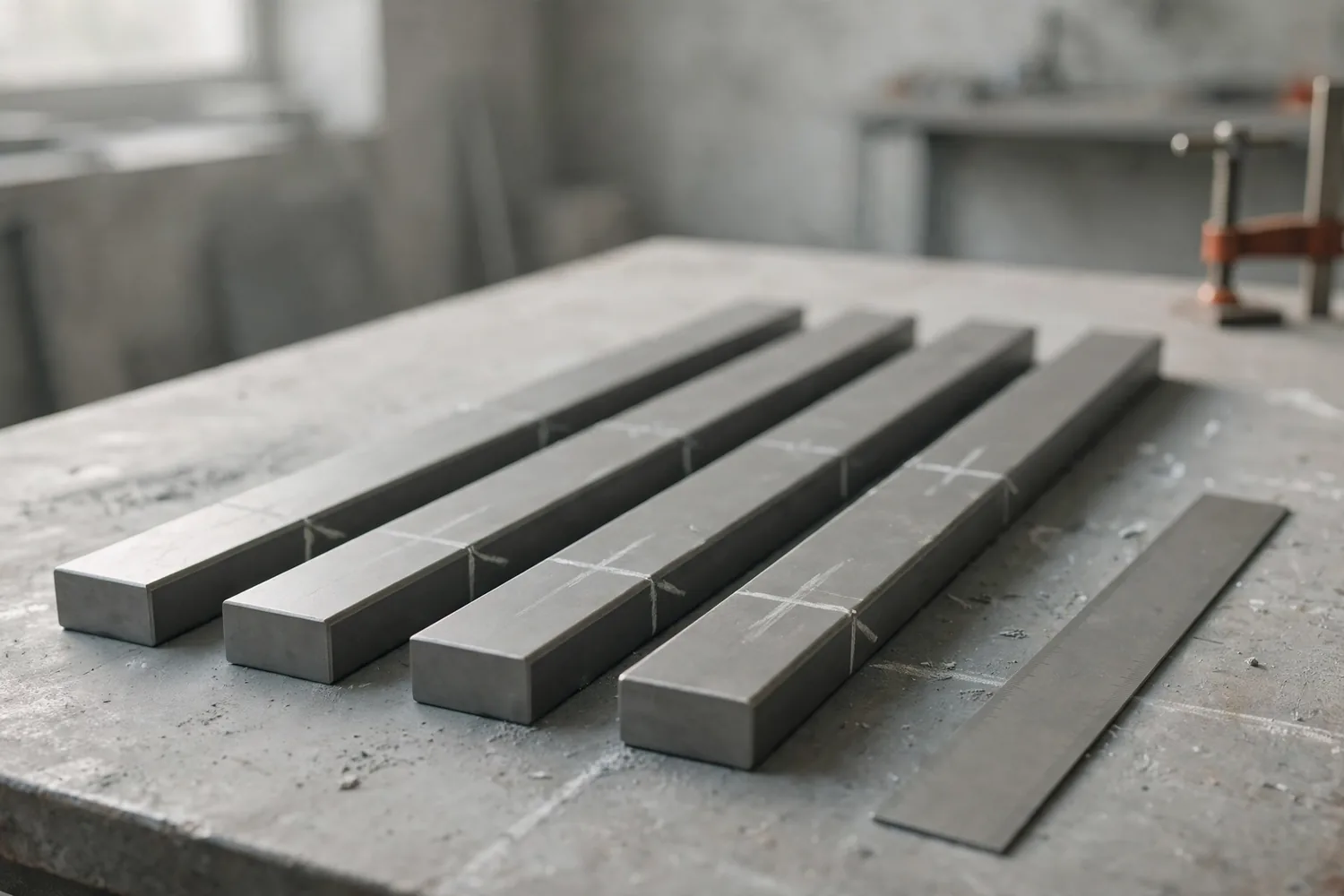
From finished part to blank, then to bars and plates, offcuts first.
Bars: best-fit decreasing
The plan works on your own bench. You list the finished parts of a job, the app turns each one into a blank and then packs the blanks into bars and plates, offcuts from your rack first.
For bars it uses best-fit decreasing: the longest blank goes first, into the open bar or offcut where it leaves the least length over. A new bar is opened only when nothing on the rack fits. Every cut costs one saw kerf, except a last piece that fills the bar exactly. End trim and the chuck stub you set in Shop rules are kept off the usable length.
Worked example: brass C36000 1 in round, kerf 2 mm, rack offcut R-0003 of 640 mm, blanks 8 × 180 mm and 6 × 95 mm. R-0003 takes 3 × 180 and leaves a 94 mm short end. One new 3,66 m bar takes 5 × 180 and 6 × 95 and leaves 2168 mm, which goes back on the rack as a new offcut. Yield is 94,3 %.
Yield is the length of the blanks divided by the blanks plus kerf, end trim and short ends. A leftover long enough to keep is not waste: it becomes a tagged offcut for the next job. For a whole job the app gives the yield by weight, plate included, so it can differ from one bar's yield.
From finished part to blank
A turned part needs a blank a little bigger than the finished size. The app adds your diameter allowance and picks the next size in your size list: a finished Ø 22 mm with 2 mm allowance needs at least 24 mm, so it takes 1 in (25,4 mm) bar.
Each blank is also a little longer: finished length plus the facing allowance at both ends. With 1 mm per end, a 178 mm part needs a 180 mm blank.
Cored bar works both ways: the outside must be at least the finished outside plus the allowance, and the bore at most the finished bore minus the allowance.
Flat, square, hex, tube and angle are used as supplied. The allowances are planning values you set for your own machines; they are not engineering advice.
Plates: shelves across the sheet
Plate parts are turned so their short side is the height (unless the rolling direction matters),
sorted tallest first and laid in rows across a plate offcut or a sheet. Each part takes the first row where it fits; a new row starts on top of the last one, one kerf higher.
Every cut runs edge to edge, so a shear or a saw can make it. Strips at the row ends and on top go back on the rack when both sides reach your minimum.
The worked example
R-0003 3 × 180 mm, kerf 2 mm each, short end 94 mmNew bar 1 (3,66 m) 5 × 180 mm, 6 × 95 mm, kerf 2 mm each, keeps 2168 mm as a new offcut
Theoretical weight
Every weight in the app is a theoretical estimate: the cross-section area times the length times the density of the grade.
Round πd²/4; square a²; hex across flats 0,866 s²; flat width × thickness; cored bar π(OD² − ID²)/4; round tube π(D − t)t; square and rectangular tube with a corner radius equal to the wall; equal angle t(2a − t). kg per metre = area in mm² × density in g/cm³ ÷ 1000.
Real pieces differ. Published tube masses run 1,4 % to 7 % above the plain formula, angles up to about 3 %, and cast cored bar may come oversize.
A seller may weigh what it sells or work it out its own way: ask ERA GOLD whether it would sell by theoretical or by scale weight.
Source: Decreto 1074 de 2015 (legal metrology, sale by weight), Función Pública – read it
Next
Plan a cut list
List the parts and the offcuts you already have. The planner works in your browser and keeps nothing.